SEND Update March 2026
Welcome to the latest edition of the SENCo Noticeboard! In this issue, we look back at the last set of SENCo Briefings, provide important information on the OAG, and share new developments in the world of SENAR. We hope you enjoy reading through!
This Update Includes
- SENCo Briefing: Feedback from Spring 2026
- Are you ready for the Online OAG?
- OAG parent carer guides now available!
- The Inclusion House
- DBV Workstream Two Update: reviewing high-needs top up funding arrangements
- SENAR: Changes to improve EHCP Timeliness
- Every child deserves a good start: updated transition guidance and Y6/Y7 form now available
- How schools can work with SENAR to resolve concerns
- Autism & Me: Empowering Young People to celebrate their autistic identity
- The Autism Education Trust (AET) is now the Neuroinclusive Education Network (NEN)
- SEND Occupational Therapy Newsletter: keep up to date with our FREE training offer!
- 'Fun with Food' comes to Early Years!
- SEND OT Training: Ready, Steady, Reception!
- Speech and Language Therapy Updates
- Autism Drop-ins and workshops - please share with parent carers in your settings
- The Knowledge: Navigating the SEND Landscape
SENCo Briefing: Feedback from Spring 2026
The briefings this term were attended by over 170 SENCos from across the sector and focused on:
The Online OAG: exploring implementation in practice
This agenda item provided a walkthrough of the OAG online platform, detailing its structure, resources, and showcases, and discussed its role in supporting strategic SENCOs and classroom staff, with feedback sought for further development. Please see the OAG item below for further details and an opportunity to access the Online version currently in development.
Support around medical needs: Developing a Template policy and the concept of the Medical Needs Advisory Partnership Panel MNAPP
This agenda item detailed the current and planned support for medical needs in schools, including statutory guidance, the development of a template policy, essential criteria checklist, and the creation of the Medical Needs Advisory Partnership Panel (MNAPP) for real-time advice and partnership working. Schools are invited to share their thinking around the advice, training and support they would like to see planned by completing the short survey via the link. Further information to follow during the summer term.
Complete the SENCo Briefing Medical Needs Survey!
The slides shared at the briefings are available below:
Are you ready for the Online OAG?
As shared at SENCo Briefings this week, the Ordinarily Available Guidance Online is getting ready to launch next term.
The online platform mirrors the original word version of the OAG by being divided into two main areas:
Section One: Expectations for All Settings: this includes the updated principles for inclusive education, reflecting feedback from schools, settings, families, and partners. It provides clear descriptions and expectations for all settings, supporting SENCOs in their strategic role.
Section Two: Classroom Practice: this section offers strategies and resources organized around the SEND Code of Practice's four areas of need, with guidance for early years, school age, and post-16. The platform provides practical strategies, what teachers might see, and links to further resources and showcases.
Showcase Cards and Resources: Thank you to those settings who have put themselves forward to showcase good practice linked to the OAG. We have used these to develop a Showcase Card, including video stories, slide decks, and practical guides. These resources illustrate real-life implementation and are accessible via icons on the platform.
Feedback and Continuous Improvement: Feedback from SENCo briefings has been really positive, with comments such as:
- “It’s a million times more user friendly, which I think will really impact the take up”
- “It’s empowered teachers and stopped that corridor conversation of ‘this child’s got needs' sorted out now.”
- “I am genuinely looking forward to sharing the digital version of the OAG with my staff as I can see it is going to be so supportive. I think it is the most useful tool we will have had for a long time (since the hyperlinked toolkits) to really offer practical, on the ground SEND support for staff in schools. I appreciate what a big piece of work it has been, so again, thank you and to your team.”
We are still seeking views on the online platform, so we are inviting schools to look at this with their staff while it is still in development – your feedback will shape the Online OAG ready for going live next term. Please click here for a link to the site and insert the password ‘oag-testing’. Local SENCo groups are also invited to look at this together! Please share your feedback with us!
OAG parent carer guides now available!
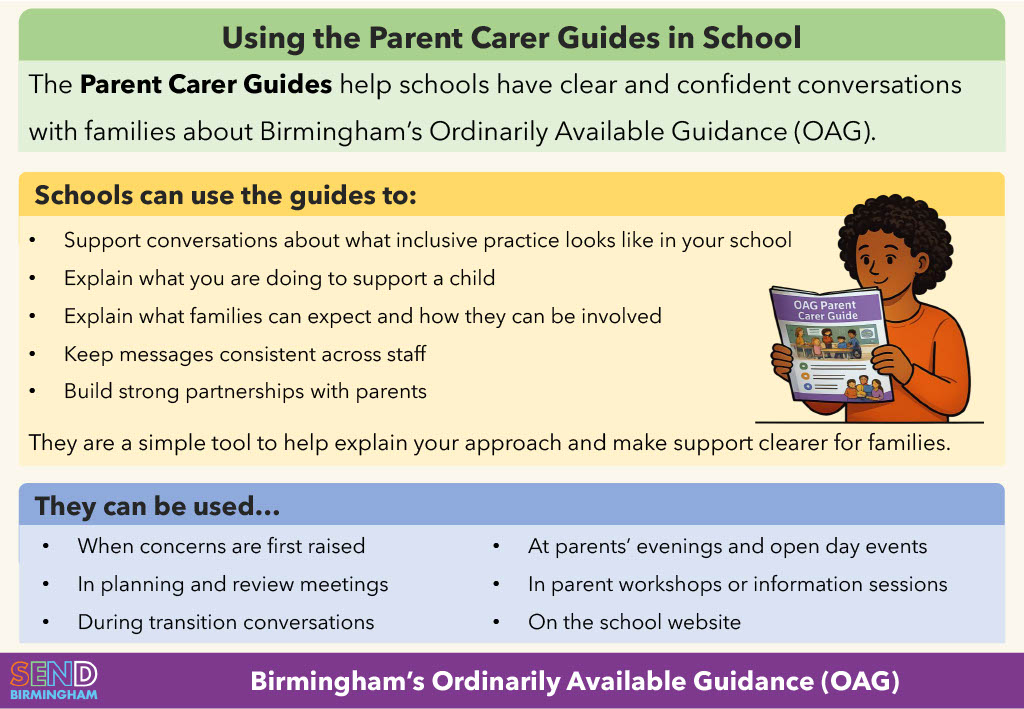
As the Ordinarily Available Guidance (OAG) has been developed, parent carers told us they wanted something alongside the guidance that clearly explains what the OAG means in practice and how schools can support their child. They wanted straightforward language that supports confident conversations with schools. In response, the OAG Parent Carer Guides have been co-produced with parent carers.
Download OAG Parent Carer Guides
We hope schools find these guides helpful in strengthening partnership with families. They can be used alongside meetings and SEND support conversations to build shared understanding. We would welcome feedback from schools, and from the parent carers you share them with, to make sure they are helpful in practice.
Microsoft Form for feedback - Microsoft Form
The Inclusion House
We are currently developing the Core Offer digital platform, known as the Inclusion House, which will serve as a central portal for inclusion-related resources, support, and training across Birmingham schools and settings. Schools will have been made aware of this through HT consortia meetings taking place this term where this concept has been shared and feedback gathered to shape the visual before this goes live.
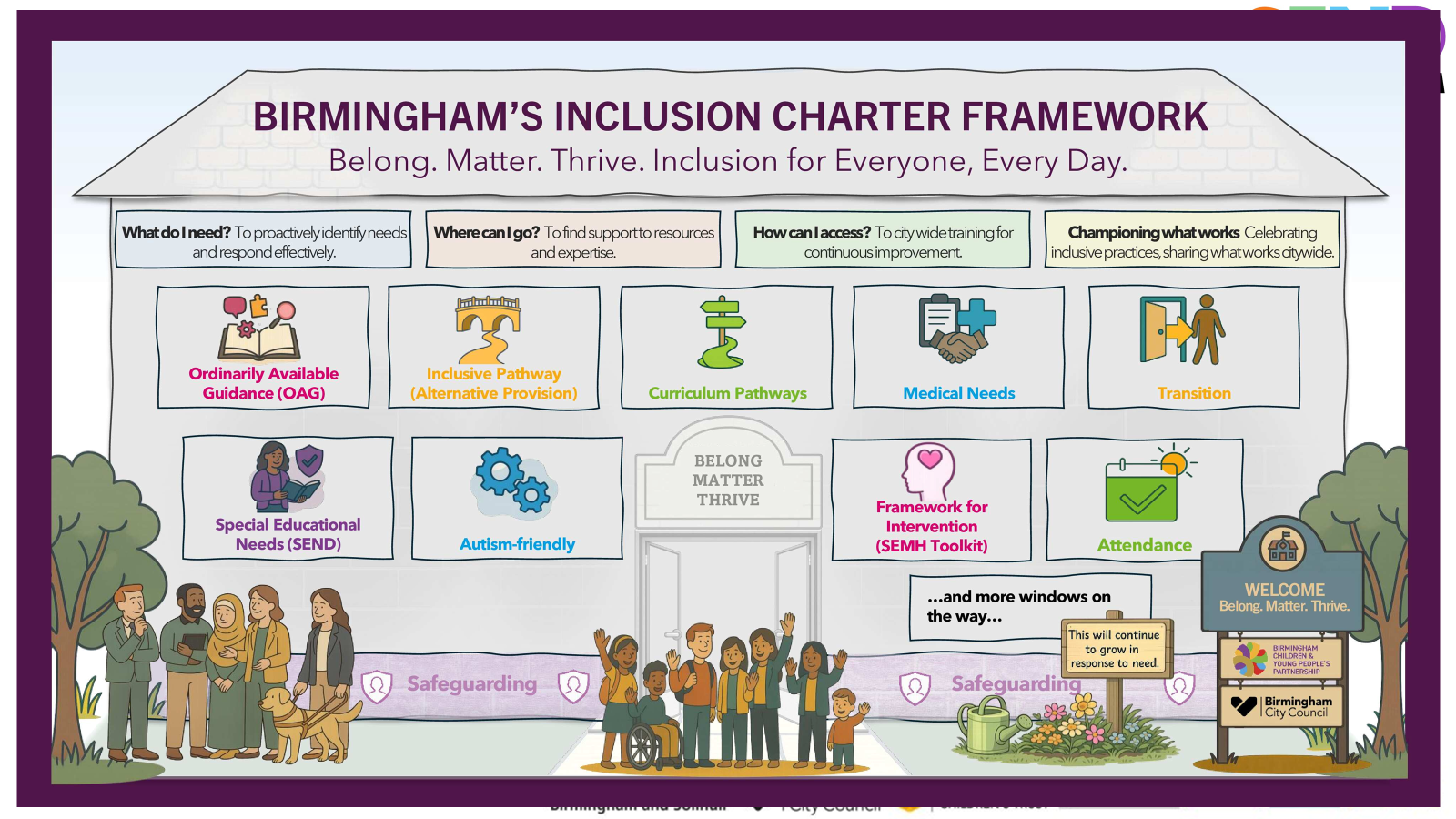
The Inclusion House is designed as a one-stop digital portal for professionals, featuring 'windows' for various inclusion topics such as SEND, attendance, Transition, and medical needs, with plans to expand to other aspects promoting inclusion such as English as an Additional Language etc.
Each window is planned to provide access to needs identification tools, support resources, citywide training (including webinars and downloadable materials), and examples of effective practice, streamlining access for schools and settings to inclusion support.
The platform is scheduled for a phased launch at an Inclusion conference in June, but in the meantime, we are working on the architecture of the windows within the House and are keen to gather feedback from schools regarding what this could look like. Please follow the link to share your ideas. Inclusion Core Offer – Digital Platform – Fill in form
DBV Workstream Two Update: reviewing high-needs top up funding arrangements
Delivering Better Value Programme Workstream Two focus is reviewing high needs grant top up funding arrangements, including SEND Support Provision Plans; to ensure that there is clarity for schools and settings about how much money for identified provision they will receive for each pupil and how the decision about funding has been made.
Work is currently underway to revise current provision descriptors for the new funding framework. The phase one workshops took place in January and February 2026. We are seeking ongoing engagement from schools and other stakeholders to support Phase 2 developments that will start in the Summer Term to review and refresh the graduated provision levels. Please send expressions of interest to the DeliveringBetterValue@birmingham.gov.uk. Please look out for more information about these workshops as we will be sharing additional detail via Headteacher forums during this half term.
SENAR: Changes to improve EHCP Timeliness
Here's an update on a step we are taking to improve timeliness in finalising plans and releasing funding for children and young people.
We fully recognise how important it is that statutory twenty week timescales are met so that children and young people receive the right support as quickly as possible. We also understand the frustration and anxiety caused when delays occur.
Despite our best efforts, some delays remain outside of the local authority’s direct control. These include, for example, delays in receiving essential advice from other services or challenges within the wider system. We continue to work closely with all partners to reduce these delays and to improve our shared responsiveness.
One of our main reasons for delay relates to sufficiency challenges. When a child or young person is awaiting a place at a resource base or specialist provision but is attending a mainstream school, our current standard practice is to not finalise before/in line with the twenty weeks until the specialist placement is confirmed. As a result, the child remains in their mainstream school without the additional funding an EHCP would ordinarily release.
To address this and ensure that statutory deadlines are met more consistently, we will be implementing a change to our practice.
Going forward, where a child or young person is attending a mainstream setting and we are still consulting with specialist provisions, we will name the current mainstream school in the final EHCP. This will allow us to meet the statutory timescale and release the necessary funding to support the child or young person sooner.
Families, young people, and settings will be informed when this happens. We will make it clear that:
- the mainstream school is being named to meet statutory obligations and secure funding in a timely way, and
- the local authority will continue to monitor for available places and consult when appropriate.
We hope this approach ensures both transparency and more timely support.
Understandably, settings may have questions regarding fulfilling the provision in Section F. Please contact your SEN services and SENAR so that we can work collaboratively to ensure that Section F is delivered.
We appreciate there also may be questions regarding funding. In line with current practice, if required, the 6+ funding for pupils requiring Resource Bases and 6+(S) for pupils requiring specialist provision will be made available.
We will also be offering further Q and A sessions to answer any further questions. Dates of this will follow. Please complete the Q&A Sessions Form to add your name to the email list.
Thank you for your continued partnership and commitment to our children and young people.
Every child deserves a good start: updated transition guidance and Y6/Y7 form now available
Schools are advised that the updated ‘Every Child Deserves a Good Start’ transition guidance and the accompanying Primary to Secondary Transition Form are now available. These resources are designed to support a smooth and well-informed transition for every year 6 pupil moving to secondary school.
Please access the updated documents here:
Thank you for your continued support in helping ensure every child receives the strongest possible start to their secondary education.
Should you have any queries or require support please contact: John McInerney, School Improvement Advisor – John.Mcinerney@birmingham.gov.uk, or Lisa Smith, Virtual School Headteacher – Lisa.Smith@birmingham.gov.uk.
How schools can work with SENAR to resolve concerns
SENAR is committed to fostering a constructive, supportive partnership with all educational settings across our local area.
SENAR operates on a relational and restorative foundation, prioritising open dialogue, mutual respect, and solution-focused collaboration. We recognise that differences of opinion or misunderstandings may arise from time to time. Our approach is designed to address such matters constructively, ensuring that all parties feel heard and valued whilst working towards positive outcomes for children and young people.
We encourage schools to engage proactively with SENAR staff, sharing perspectives and feedback in a manner that supports learning and improvement. Our team is committed to responding professionally and supportively, seeking resolution through discussion and reflection rather than escalation.
It is important to clarify that schools do not have a formal right or route to complain about SENAR decisions or communications via the local authority’s official complaints procedure. Should you have concerns or queries regarding SENAR’s actions or decisions, these should be raised directly with the relevant SENAR staff member. Open, direct communication helps us address issues swiftly and collaboratively, without recourse to formal processes.
If you are unsure whom to contact within SENAR regarding a particular matter, please consult the Local Offer guidance. The Local Offer provides comprehensive information on SENAR contacts, roles, and processes, ensuring you are directed to the appropriate individual or team for your concern. SENAR - Local Offer Birmingham
For clarity, the formal complaints procedure administered by the local authority is reserved for use by our families as this is their route to escalate externally should they chose to do so. This process does not extend to schools or educational staff in relation to SENAR decisions or communications. Our preferred method is to resolve any school/settings-related concerns through direct engagement and restorative conversation.
We value the ongoing partnership with schools and appreciate your dedication to supporting children and young people with special educational needs. SENAR remains committed to working collaboratively, addressing challenges constructively and ensuring the best possible outcomes for all. Should you require further clarification or support, please do not hesitate to contact us.
Autism & Me: Empowering Young People to celebrate their autistic identity
The Communication and Autism Team (CAT) and the Birmingham Parent Carer Forum (BPCF) have spent the past year working with eleven Birmingham secondary schools through the Autism in Schools Project. Together, they have focused on strengthening autistic identity, improving inclusive practice, and supporting better outcomes for autistic pupils and their families.
Each school has appointed an Autism & Me Ambassador; a trained member of staff who has completed Good Autism Practice, Anxiety, Executive Function, and Autism & Me Facilitator training. Ambassadors have since delivered a structured programme helping autistic pupils develop a positive sense of identity, understand their needs, recognise their strengths, explore sensory differences, and connect with peers.
Pupil feedback has been overwhelmingly positive, with many reporting increased confidence, self-esteem, and a stronger sense of belonging:
- “I have really enjoyed learning about my autistic identity and ways I can help myself.”
- “I have learnt so much about myself and that I am not alone.”
- “I now understand my strengths and can explain my sensory needs better.”
Ambassadors have also partnered with BPCF to deliver two parentcarer workshops in each school: an introduction to Autism & Me, and a celebration of each child’s journey. These sessions have strengthened relationships between schools and families and supported a shared understanding around each young person.
As the project enters its final phase, schools are completing the last pupil sessions, delivering the second parent carer workshop, and gathering feedback. This pupil and parent voice will be central to evaluating Autism & Me and shaping its future development, ensuring the programme remains meaningful and reflective of autistic young people’s lived experiences.
The Autism Education Trust (AET) is now the Neuroinclusive Education Network (NEN)
Through evidence-based training and collaboration, the Neuroinclusive Education Network (formerly known as the Autism Education Trust) supports Local Authorities, Multi Academy Trusts (MATs), training organisations, schools and education professionals to create inclusive environments where every neurodivergent learner can thrive.
The name change comes with assurance that autism expertise remains at the core of the Neuroinclusive Education Network’s core, which will now be strengthened by an inclusive perspective that supports wider neurodivergence including learners with ADHD, dyslexia and Tourette Syndrome.
The Communication and Autism Team will continue to use the NEN/AET Standards with settings in Birmingham and will continue to provide the NEN/AET Training modules as they are reflect evidence based inclusive practice in education and autism.
SEND Occupational Therapy Newsletter: keep up to date with our FREE training offer!
Welcome to our SEND Occupational Therapy Newsletter
Our SEND Occupational Therapists and Senior Therapy Assistants deliver FREE universal and targeted support to private, independent, voluntary (PVI) settings, local authority (LA) nursery schools and mainstream schools in Birmingham.
We have a variety of training available; we cover topics around feeding, sensory, activities of daily living and motor skills. We provide family webinars, online training and face to face training for mainstream settings.
If you would like to attend our FREE webinars, you will find links availble in our newsletters linked below..
If you would like to book any SENCo advice meetings or sign up to any of our face-to-face training (FunMoves, Sensory Circuits, Fun with Food, Ready Steady Reception, OT Champs) please email us at bchc.sendtherapy@nhs.net
Please view our SEND OT Newsletters below:
If you would like to subscribe to receive our newsletter via email, please join our mailing list by emailing us or contacting your OT
'Fun with Food' comes to Early Years!
Fun with Food is a NEW group that has been running in early years nursery settings in Birmingham. This group has now been extended to reception children in mainstream schools. The group has an Occupational Therapy and Speech and Language Therapy focus supporting children with food play.
A pre-group training course is run by Occupational Therapists and Speech and Language Therapists to train your staff member in eating, drinking and food play.
Once you have attended the training, the same staff member will be supported to run a Fun with Food group in their setting/school. The aim of the group is to support children to engage in food play through a multi-sensory approach. The group has received great feedback from educational staff.
| Weeks | Topic |
|---|---|
| 1 | Introduction to 'Fun with Food' group and expectations/ commitments (virtual for 1 hour) |
| 2-4 | The SEND team support with carrying out a 'Fun with Food’ group in person, in the early year’s environment |
| 5 | The SEND team support with carrying out a 'Fun with Food’ group in person, in the early year’s environment, Parents are encouraged to attend this last session |
Please view our poster for further information
Email us on bchc.sendtherapy@nhs.net to show your interest and join our waiting list.
The group is open to 1 or 2 staff members per early years setting/school, preferably the staff member/s who will be running the sessions, the SENCO can attend as the second staff member.
We look forward to supporting you with running your groups in your settings/reception classes.
SEND OT Training: Ready, Steady, Reception!
We can support you to set up a ‘Ready, Steady, Reception Group' in your early years setting/mainstream school. One of our senior therapy assistants who are dual trained in Occupational Therapy and Speech and Language Therapy will come and support you with these groups.
The first introduction session is online, the following 5 sessions are in your setting/ school working on communication, feeding, toileting, dressing and prewriting skills.
You will be supported to use our skills checklist to identify appropriate children for this group.
All of our training and support is FREE and does not require a referral into our service to support you.
We are passionate about upskilling the workforce in Birmingham so please get in touch to enquire.
Speech and Language Therapy Updates
Identification of Speech, Language and Communication Needs (SLCN)
Speech and Language UK have a range of free resources available for schools to support the identification of children and young people’s SLCN, including information, posters, documents and a progress checker. Go to www.speechandlanguage.org.uk/educators-and-professionals/ages-and-stages for more information.
Developmental Language Disorder (DLD) Together
The SaLT and LLaSS team have received positive feedback from parents who attended the DLD Together pilot parent/carer group in the autumn term 2025: “I would recommend the DLD course to other families because it provides clear, practical strategies that actually make a difference in everyday communication. The course helped us understand what DLD really is, reduced a lot of stress and confusion, and gave us tools we could start using right away at home. It made us feel more confident supporting our child, and it also connected us with other families who are going through similar experiences. Overall, it’s supportive, empowering, and genuinely helpful for both children and parents.”
A pilot is running in the spring term 2026 for parents/carers of primary aged children with DLD. For more information see DLD Together Spring 2026 Primary.
ProveIt! Balanced System®
The SaLT team are starting to use the ProveIt! Balanced System® platform during the spring term 2026 to capture the evidence of impact and outcomes for SLCN and OT support at universal, targeted and specialist levels. Look out for more updates via your Link SLT.
Rooms for SaLT School Stammering Groups
The SaLt team are keen to put on some groups across the city to support children who stammer. These groups would run during the holidays and we are looking for spaces within local communities. If your setting can offer any support with this please contact bchnt.childrens.slt@nhs.net
Autism Drop-ins and workshops - please share with parent carers in your settings
Welcome to the next round of workshops for parent carers! Our Workshops are designed to share knowledge, skills and strategies to enable parent carers to further support their autistic child/young person.
Please signpost these events to the parent carers in your setting; your CAT will be bringing flyers into school to share with families. Book now!
CAT Parent carer Themed Workshops – Meet CAT – face to face
13.03.2026 - 9.30-2.30pm - GROW Event Sutton Coldfield B75 5BW
18.03.2026 – 11.30-1.30pm - CitiSen – The Rise Club B42 2BJ
CAT Parent carer Themed Workshops –face to face
24.02.26 - 9.15-10.45am Wyndcliffe Junior School ‘Language and Communication.’
03.03.26 - 9.15-10.45am Wyndcliffe Junior School ‘Sensory Differences.’
10.03.26 - 9.15-10.45am Wyndcliffe Junior School ‘Emotional Regulation.’
17.03.26 - 9.15-10.45am Wyndcliffe Junior School ‘Sleep.’
24.03.26- 9.15-10.45am Wyndcliffe Junior School ‘Promoting Confidence and Independence.’
CAT Parent carer NEN Anxiety Workshops online
26.02.26 – 1.00-2.30 pm – online
12.03.26 - 9.30-11.00am – online
CAT Parent carer NEN Toileting Workshops
05.03.26 - 1.00-2.30pm - online
19.03.26 - 1.00-2.30pm - online
26.03.26 - 1.00-2.30pm - face to face / venue to be confirmed.
In addition, please promote the online bespoke advice sessions that parents carers can book; these provide an opportunity for parent carers to discuss their individual child and ask questions. Your CAT will bring in fliers to promote these sessions which are bookable via the Local Offer.
CAT Parent carer Advice Sessions online
16.03.26 – 9.00-12.30pm
23.03.26 - 9.00-12.30pm
The Knowledge: Navigating the SEND Landscape
Online Training for Supporting Children with Attention Deficit Hyperactivity Disorder (ADHD) in Schools
This two-hour, online training will be delivered by an Educational Psychologist and will explore what ADHD is and how the traits associated with the diagnosis impact children in primary and secondary school. It aims to dispel common myths by exploring how the condition is presented in popular media and developing staff understanding through evidence-based information about the condition. This training will provide staff with practical, evidence-based, inclusive strategies which they can use in their classrooms when supporting children who have ADHD. The training will include discussion time and support so that staff feel able to make practical plans for implementation of the strategies presented within their own practice.
Outcomes:
- For staff to develop their understanding of what ADHD is and recognise how the condition might impact children in their school.
- For staff to learn about evidence-based strategies to support pupils who have ADHD and to feel confident in their ability to implement these in their classroom and wider school.
The cost of each training session is £66 per person.
For more information, see the following flyers:
Supporting social communication and interaction differences: The SCERTS framework
SCERTS is a strength based, multiagency approach, building on what is already working and bringing together parents/carers and professionals who support the child. It’s an evidence-based approach that can be used in all settings, with children who are nonverbal, to those with lots of language who may be struggling with the social rules of interaction. A child doesn’t need an Autism diagnosis to use this framework. SCERTS utilises an assessment process that allows the most important outcomes for the child to be identified and then follows a plan/do review cycle. SCERTS provides progress data, so is helpful for pupils who may already have a SSPP, EHCP or are working towards one of these and so require a graduated approach.
Outcomes:
- Understand the theory behind social communication and emotional regulation.
- Use pre and post assessments.
- Identify critical skills to work on and strategies to develop these and involve parents in the process.
- Establish the differing options for delivering SCERTS in your school.
- Once you have attended this training you will be competent in using the SCERTS approach, working alongside outside agencies.
The cost of this training session is £274 per person. Reducing to £213 if there are 2 or more who attend from the same school or setting. Tea/coffee will be provided.
Autism Education Trust/Neuroinclusive Education Network Training
AET/NEN Autism and Inclusion Module: 16th March 2026 (full day)
This module aims to develop skills in identifying how autism might affect pupils' behaviour; increase knowledge around the rights of autistic pupils and the duties of schools under the Equality Act 2010; and to recognise the impact of exclusion on families, seeing the exclusion experience through the eyes of the autistic pupil.
It also aims to develop understanding of how to accommodate an autistic pupil’s needs, to avoid exclusion.
Book now: AET Autism and Inclusion 16th March 2026 - Local Offer Birmingham
AET/NEN Early Years Toileting Module: 26th March 2026 pm
This course aims to help delegates to understand the importance of working with others to support children to develop independent toileting skills, and to develop knowledge of how to support children to achieve toileting independence. Delegates will receive a practical support pack and packs to support parent carers within the home.
Book now: AET | Early Years Toileting Thursday 26th March 2026 1pm - Local Offer Birmingham
AET/NEN Early Years Developing Play Module: 26th March 2026 am
This course enables delegates to understand how the three areas of difference related to autism impact on the development of play skills; the importance of all adults working together to support the child to develop play skills; and will help delegates develop knowledge of how to support autistic children to develop play skills. Delegates will receive a 53 page practical support pack and a 3-part parent pack.
Book now: AET | Early Years Developing Play 26th March 2026 9am - Local Offer Birmingham
AET/NEN Using the AET Frameworks for Governors and Leaders: 20th March 2026 pm (via Microsoft Teams)
For leaders and governor to:
- Understand the importance of the Good Autism Practice Principles and the Inclusion Promises.
- Consider how your provision can embed the principles and promises to ensure children and young people receive a positive education.
- Understand how to embed the AET Frameworks across your provision to further develop good autism practice.
Book now: AET Frameworks for Governors and Leaders Friday 20th March 1pm - Local Offer Birmingham
Look out for more courses in the summer term.