SEND Update January 2026
Happy New year to you all. The latest SENCo Noticeboard includes information around SENCo briefings this term as well as what's happening with the OAG, Autism-friendly Birmingham opportunities and much more....
This updated includes:
- SENCo Briefings
- OAG - Invitation to have your say on the language in the OAG
- Celebrating the OAG Transition Action Research Project
- OAG - Showcase Update: There's still time to share your practice
- OAG - Early Years Action Research Midpoint Update
- Autism Friendly Reference Group
- Medical Policy
- Best practice to improve support for CYP diagnosed with Sickle Cell and Thalassaemia
- Birmingham Curriculum Pathways Reference Group
- Maximising the Practice of Teaching Assistants in Birmingham
- Language, Learning and Strategic Support Team Use of Hours Updates
- Delivering Better Value Workstream TWO: Review of banding descriptors
- Educational Psychology Service - New Ways of Working 2026/27
- West Midlands Career Hubs | IncludEd SEND Community of Practice Network
- Early Years SENIF: ISEY funding for all EY Providers
- Welcome to our SEND Occupational Therapy Newsletter
- Speech and Language Therapy Updates
- CAT Updates: Spring 1
- The Knowledge: Navigating the SEND Landscape
SENCo Briefings
The Spring term SENCo briefings are planned for the second week after February half term. These 90-minute sessions will be hosted through MS Teams and will have a two-item agenda as follows:
-
Exploring the Online OAG – Your Chance to Shape the Future
We’re preparing to launch the online version of the OAG in April, and this is your opportunity to influence how it works before it goes live. The goal? To make sure it’s practical, intuitive, and truly helpful for staff working on the ground.
Join this session to:
- Share your ideas on how the online OAG can best support day-to-day practice
- Help shape a user-friendly design that meets real-world needs
- Explore how the OAG can assist schools in preparing for the upcoming SEND reforms
Your input is vital to ensure this resource delivers maximum impact to support staff and strengthens outcomes for children and young people across the mainstream sector.
-
Support for schools and settings around Medical Needs
As many schools and settings are catering for pupils with increasingly complex medical needs we are with colleagues from across the Local Area Partnership to provide a range of support and guidance.
Join this session to find out more about:
- the medical needs policy template currently being co-produced with a range of schools and NHS services
- guidance on administering medication and providing personal care support
- development of a Medical Needs Advice Partnership Panel, where schools will be able to seek support and advice about individual medical needs issues in the context of the child and the setting.
Dates for Network briefings:
- Monday 2nd March between 13:30 and 15:00
- Tuesday 3rd March between 13:30 and 15:00
- Wednesday 4th March between 09:30 and 11:00
- Thursday 5th March between 09:30 and 11:00
The agenda items and city-wide content of each briefing will be the same. Please 'save the date’ which is best for you and look out for the sign-up links that will be circulated just before half term.
OAG - Invitation to have your say on the language in the OAG
We are inviting class teachers and support staff to take part in a short online discussion to review the language used in Section 2 of Birmingham’s Ordinarily Available Guidance (OAG). This is a chance to influence how the guidance describes what we notice in children, ensuring it reflects real classroom experience and supports shared professional understanding.
What is the session about?
We will be looking specifically at the “What we might see” sections of the OAG.
The discussion will focus on:
- whether the language is clear and easy to understand
- whether it reflects what staff actually notice in practice
- whether it helps staff talk about children’s needs in a consistent way
This session is not about developing practice or deciding what staff should do. It is about getting the language right to create a shared understanding. We want to hear from class teachers and support staff working directly with children and young people on how the OAG can help them to think about their inclusive practice.
Session detail
Session Format: 30-minute virtual meeting (Microsoft Teams)
Who should attend: Class teachers and support staff
We have scheduled multiple sessions to fit around the school day based on your age-phase. Choose one session to attend:
- Mon 26th Jan – 08:15–08:45 (Early Years)
- Mon 26th Jan – 10:15–10:45 (Primary)
- Mon 26th Jan – 12:30–13:00 (Secondary & Post 16)
- Mon 26th Jan – 15:30–16:00 (Early Years)
- Tue 27th Jan – 10:15-10:30 (Secondary & Post 16)
- Wed 28th Jan – 08:15–08:45 (Primary)
- Wed 28th Jan – 16:15 – 16:45 (Secondary & Post 16)
(Teams joining details will be shared once attendance is confirmed - To confirm your please complete the following form - Have your say on the language in the OAG! – Fill in form.
OAG Celebrating the Transition Action Research Project
Since March 2025, a variety of 11 Birmingham settings have taken part in an action research project with a focus on developing their transition practise to have better outcomes for their children and young people (CYP) and families. Settings involved in the Transition OAG Project focused on the Y6-Y7 or Nursery-Reception phase transfers. They have focused on setting up new processes to support transition, the engagement of families or supporting the anxieties of CYP.
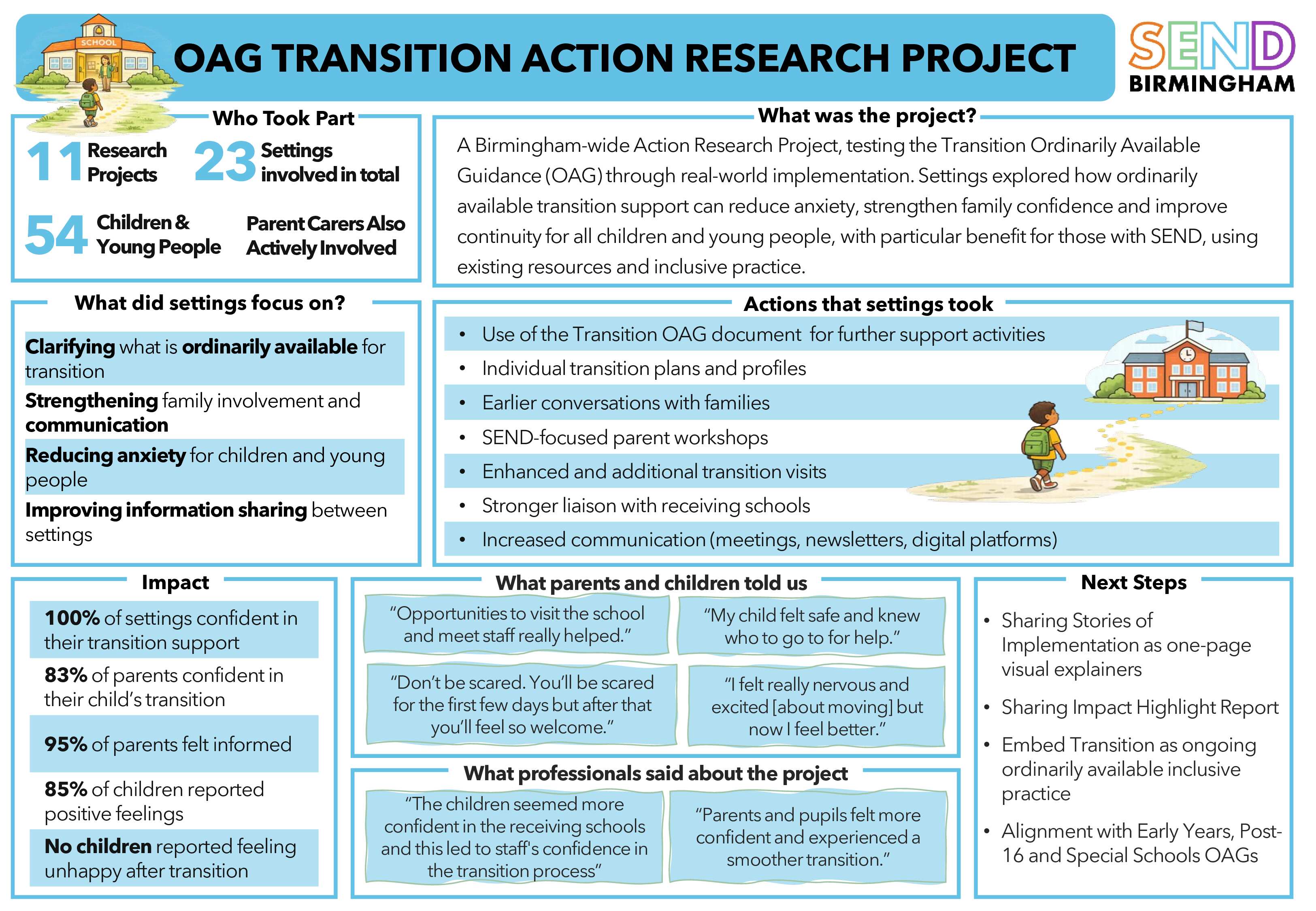
We’re delighted to share this celebration of their work and invite you to explore their Stories of Implementation including more detailed overview versions, which capture how settings and families worked together to improve understanding and confidence in the transition support available as we develop Birmingham’s Ordinarily Available Guidance (OAG).
A summary of outcomes are:
- Improved Communication: All settings enhanced communication with new schools and parent carers, not limited to those needing specialist support. Parent signposting links were found helpful.
- Development of Provision: The Transition OAG validated existing good practices and provided ideas for improvement. Signposting links supported both class staff and SENCOs.
- Cultural Change: Settings committed to embedding project practices and outlined next steps to strengthen the transition processes across the whole setting.
- Increased Confidence: Parent carers, CYP and staff reported greater confidence in transitions, appreciating extra visits, more information, and support from previous settings.
After the project, 100% of settings were confident in their transition support. Feedback from parent carers and CYP has been overwhelmingly positive.
No child felt unhappy or sad when followed up - 85% were very happy, One child said they “felt really nervous and excited [about moving] but now I feel better.” Another said that they ‘enjoy new school' and “I’m happy I came.”
95% of parents felt they were well informed. Many parents reported in feedback that their child had “settled well”. One parent said that, “Opportunities to visit the school and meet teachers who would be involved in Y7 as a reference point really helped with transition for my son.” - “My daughter felt safe and found that there are relevant staff for support when needed,” and another stated that they “Saw a great and good thing in my child.”
Stories of Implementation
OAG - Showcase Update: There's still time to share your practice
Thank you to the schools and settings who have already expressed an interest in being part of the Ordinarily Available Provision (OAG) Showcase.
We have had a really positive response so far and are currently working with a number of settings to develop their showcase ideas. These include examples of inclusive classroom approaches such as Attention Autism and sensory circuits, adaptive high-quality teaching that supports participation and engagement, and the use of graduated support plans to meet individual needs. Alongside this, we are also developing examples that show how the OAG is being embedded more widely, including staff induction models, MAT-wide universal provision approaches, and leadership narratives that demonstrate strategic implementation, reflection and oversight.
We would now particularly welcome additional or different examples linked to the following areas:
Areas we would still like to showcase
From Section 1 – Principle of Mainstream Inclusion:
- Creating Enabling Environments - How spaces, routines and resources are designed to reduce barriers and support participation.
- Transition Across the Whole Life Course - Inclusive approaches to supporting transitions between classes, phases or settings.
- Equity and Diversity - Practice that reflects fairness, inclusion and respect for difference.
- The Team Around the Child and Family - Collaborative working with families and wider professionals to support the whole child.
- Additional Needs - How settings respond to needs that may not meet SEND thresholds but still require inclusive support.
From Section 2 – Areas of Need:
- Processing - Classroom strategies that support pupils who need additional time or structure to process information.
- Spelling - Inclusive and adaptive approaches to spelling within everyday teaching.
- Sensory and Physical Needs - Practical adaptations, resources or routines that support sensory regulation and physical access.
There is still time to be involved. If your setting is doing something different to the examples above, or if you are unsure whether your idea would be suitable, we would be very happy to talk it through with you.
Please contact Heather Wood or David Hill if you would like to take part or would like to find out more.
Heather Wood heather.wood@birmingham.gov.uk
David Hill david.w.hill@birmingham.gov.uk
OAG - Early Years Action Research Midpoint Update
As the Early Years Ordinarily Available Guidance (OAG) Action Research Project reaches its midpoint, we are pleased to share a brief update on progress and learning from across participating settings. This follows a recent midpoint check-in session, which provided an opportunity to reflect on baseline findings, revisit project timelines and focus areas, and celebrate the work already underway.
The session highlighted the range of actions settings are taking, what is working well, and the learning emerging through shared reflection and discussion. Settings spoke positively about the value of hearing from one another and the confidence gained through collaborative conversations about inclusive practice.
During visits to participating settings, local authority advisers have seen strong examples of inclusion by design in action. This includes environments intentionally planned to meet a wide range of needs, staff confidently noticing and reflecting on children’s learning, and inclusive practice spreading through coaching, modelling and shared problem-solving. Strong partnerships with parents and increasing engagement in professional learning are clear indicators of a growing and sustainable inclusive culture.
The project is progressing well, with settings now moving into the next phase: continuing their actions through the spring term and developing their Stories of Implementation, capturing intent, action, impact and learning. These will be shared later this year via the SENCO Noticeboard, alongside the launch of the online OAG.
Autism Friendly Reference Group
Across Birmingham, we share a bold ambition: 'every autistic child and young person—and all those with SEND—should feel seen, heard, understood, and supported to thrive in an autism-friendly city.'
Yet too often, families experience fragmented systems and inconsistent support. That’s why, with backing from the Education Endowment Foundation during Spring and Summer 2025, Birmingham partnered with Derby Research School to co-create a long-term plan for change.
Using the Theory of Change model, professionals, parents, and carers worked together to explore:
- The challenges faced by autistic young people, families, schools, and services
- The support needed to overcome these challenges
- The behaviours and actions required to make inclusion real
- The shared aims for the next three years
What Does the Three-Year Plan Include?
- Autism Champions across sectors
- A Birmingham Autism Statement and Reflective Framework
- Shared Directories for easy navigation
- Training Pathways and CPD for practitioners
- Strong transition support for young people
- Strategic engagement with employers, HEIs, FE, and training providers
- Cross-sector collaboration
- And at its heart: the Birmingham Co-Production Charter
This plan is about moving beyond good intentions. It’s about embedding autism understanding across the whole system—creating shared language, consistent frameworks, and clear pathways that reflect real lives and enable person-centred support. Every practitioner, in every school and service, must be equipped to recognise, respect, and respond to autism.
Why Your Voice Matters
The golden thread running through this plan is systems leadership—ensuring parents, young people, and colleagues from across partnerships are part of shared learning and can cascade implementation models back into their teams.
To make this happen, we’re forming an Autism-Friendly Steering Group. This dynamic group will meet half-termly to provide oversight, guidance, and scrutiny of the three-year delivery plan.
Get Involved
If you’re passionate about inclusion and want to help shape Birmingham’s future, we’d love to hear from you.
Email Sarah.J.Scarr@Birmingham.gov.uk (Team Lead, Communication and Autism Team) to find out more or express your interest.
Medical Needs Policy
Schools and settings are increasingly supporting children and young people with complex medical needs, and Birmingham City Council is committed to providing clear, practical guidance to help you do this confidently and safely.
We are currently co‑producing, in partnership with a range of schools and NHS colleagues, a comprehensive Medical Needs Policy Template. This will be accompanied by guidance on the administration of medication and the provision of personal care support, ensuring schools have access to consistent and up‑to‑date information.
To further support schools in navigating complex or individualised situations, we are also proposing the establishment of a Medical Needs Advice Partnership Panel. This panel will offer a space for schools to seek advice on specific medical needs issues in the context of individual pupils and their settings. The panel will bring together expertise from both health and education, with the aim of providing constructive guidance, helping schools to meet the needs of children and young people with medical needs effectively and confidently.
For further information please contact Amanda Wiser, Team Leader for Sensory and Physical Support - amanda.wiser@birmingham.gov.uk
Best practice to improve support for CYP diagnosed with Sickle Cell and Thalassaemia (SCaT)
Creating truly inclusive schools means recognising the vital role education plays in the lives of children and young people living with long-term health conditions. For those diagnosed with Sickle Cell and Thalassaemia (SCaT), this is especially important. Research shows that many schools struggle to provide the right support, often due to limited understanding, lack of knowledge, and, in some cases, racial bias. These gaps can lead to significant barriers and inequalities in education.
SCaT is a serious, lifelong, and often invisible blood disorder that affects multiple systems in the body. While every child is unique, common symptoms include severe fatigue, paleness, shortness of breath caused by low oxygen levels, and anaemia. These challenges can impact learning and wellbeing if not properly addressed.
We have been working with the Organisation for Sickle Cell, Anemia Relief, and Thalassaemia (OSCAR) and health colleagues to develop gudiance for schools on the best practice in supporting children and young people diagnosed with Sickle Cell or Thalassaemia - ScAT Guidance for Schools. This guidance aims to empower senior leadership teams, teachers, and support staff to:
- Build a deeper understanding of SCaT and its impact
- Avoid assumptions and prejudices
- Ensure smooth communication between teaching and non-teaching staff
- Improve educational provision for affected pupils
- Access expert advice and guidance from NHS specialist healthcare teams
Emma Chambers, Strategic Commissioning Manager at Birmingham Integrated Care Board, emphasises: “While our primary focus as an NHS organisation is the health of those living with sickle cell and thalassaemia, we also recognise the critical importance of improving support in schools. This is not only about safeguarding mental health but ensuring every child and young person can thrive and reach their full potential despite living with a long-term condition.”
To find out about more SCat, and the work of OSCAR, please see their website.
Birmingham Curriculum Pathways Reference Group
The Birmingham Curriculum Pathways Reference Group is being established to support the ongoing development and implementation of the inclusive curriculums within Birmingham and we are inviting you to be part of it.
The Birmingham Curriculum Pathways Reference Group will:
- Consistently support and hold partners to account for their part in the success of the ongoing development and implementation of the curriculum pathways project.
- Be completely aligned to the project outcomes.
- Listen to families, children and young people throughout.
The Reference Group will be involved in completing key activity as outlined in the curriculum pathways project plan, monitoring and review progress as well as impact. The group will be responsible for identifying gaps in activity and any additional areas for improvement. The role of attendees at these meetings will be to communicate and feedback to and from the wider system and network, ensuring that there is engagement by all relevant partners from across the local area.
Meetings will take place on a monthly basis and will have the following responsibilities:
- To focus on improving the curriculum offer to C&YP requiring an alternative or enhanced curriculum.
- Interface effectively with existing and emerging systems of support. This includes the identification and understanding of issues / areas for improvement
- To share knowledge and experiences in a reciprocal way in order to understand issues and blocks.
If you would like to find out more information and register your interest in being part of the Curriculum Pathways reference group, please contact Terri Cawser (terri.cawser@birminghamg.gov.uk).
Maximising the Practice of Teaching Assistants in Birmingham
The SEND Advisory & Inclusion Service is offering a limited number of fully funded places for the nationally recognised MPTA programme, designed to improve the effectiveness and impact of Teaching Assistants (TAs) in schools.
Key Highlights:
- Developed in response to EEF research to help schools rethink TA deployment, support, and development
- Provides practical strategies, tools, and case studies to embed sustainable, high-impact TA practices
- Focus areas include scaffolding learning, promoting independence, and supporting pupils with SEND within a whole-school improvement framework
- Delivered in partnership with LL&SS and CAT, including face-to-face sessions and guidance on evaluating impact
Eligibility:
Priority will be given to schools that have identified TA development as a strategic focus with LL&SS or CAT.
Next Steps:
To express interest or find out more, contact Rebecca Hughes at Rebecca.Hughes@birmingham.gov.uk.
Language, Learning and Strategic Support (LL&SS) - Update on the use of hours
The Language, Learning and Strategic Support Team have been working with SENAR and the SSPP funding group to look at how we can make the best use of the hours we allocate to schools, whilst also ensuring schools have sufficient evidence of involvement in the graduated approach when seeking statutory assessment and funding for an SSPP.
Representatives from LL&SS will be attending the Local Area SENCO consortia meetings being held over the next couple of terms to discuss what this looks like in practice. Therefore, can we ask that you prioritise attendance at these meetings as much as possible to ensure that you are part of these discussions.
If you should have any specific questions about the support that LL&SS provide you can contact Terri Cawser (Team Lead for LL&SS) at terri.cawser@birmingham.gov.uk.
Delivering Better Value Workstream Two: Review of Banding Descriptors
A reminder of the invitation that was shared in December’s SEND and Inclusion Bulletin
Purpose
Workstream 2 continues to be in the options development stage regarding future top up funding frameworks. It is important to start having exploratory conversations with stakeholders to review the current descriptors so that we have principles in place to develop more detail with the chosen framework option. A series of workshops are being held in January and February with each having a focus around the category of need. We are inviting expressions of interest to support this work.
Background
The Education, Health and Care Plan (EHCP) and appendices should identify the level of need and provision required by children and young people in Birmingham to enable their needs to be met and for them to receive the right level of provision. Currently the local authority uses primarily two banding guidance documents; ‘Ranges’ for early year settings, mainstream schools and resource bases, and Banded Descriptors for Special Schools, to identify the appropriate level of funding that a child or young person will receive.
In response to the commitment that the new chosen framework remains needs led and a child centred approach, we need to be ensure confidence that the current descriptors continue to demonstrate a graduated response of provision to need, including congruence between to the two documents as well as demonstrating clear additionality to the guidance on ordinarily available provision.
All the workshops will explore these themes
- How are we using the descriptors in the current guidance
- Levels of confidence with familiarity and interpretation
- Has the implementation of the OAG changed perspectives
- Are the two documents congruent – the strengths and the anomalies regarding the description of graduated provision in response to the complexity of need.
- What will need to be the focus for additional detail
The workshops are just the starting point of the review of the descriptors in both guidance. We will follow up with more consultation with practitioners and stakeholders. Following decisions about chosen options there will be further meetings to develop and complete the review of the descriptors in the Spring Term.
Below are the workshop dates and the category of need focus. Currently the venues for all the workshops are provisionally booked at the Council House and we will confirm with participants the venue details and alternatives if agreed.
| Workshop | Date | Time | Area of Need Focus | Venue |
|---|---|---|---|---|
| 1 | Wednesday 21st January 2026 | AM | Communication and Interaction (SCLN/Autism) | Council House |
| 2 | Wednesday 21st January 2026 | PM | SEMH | Council House |
| 3 | Thursday 22nd January 2026 | AM | Physical and Medical | Council House |
| 4 | Thursday 22nd January 2026 | PM | Cognition and Learning | Council House |
| 5 | Monday 2nd February 2026 | AM | Communication and Interaction (SCLN/Autism) | Council House |
| 6 | Monday 2nd February 2026 | PM | SEMH | Council House |
| 7 | Wednesday 4th February 2026 | AM | Sensory | Council House |
Expressions of interest can be sent by completing the form below.
Educational Psychology Service - New Ways of Working 2026/27
The service welcomed the engagement of schools with our short series of webinars held on the 1st and 2nd December 2025. The webinars shared information about changes to our service delivery for the next traded year 26/27 beginning April 26. Several drivers have necessitated a critical look at the EPS’ current traded service delivery model which has been in place since 2011. We wanted to share our thoughts with schools about the current context, what is working well as well as the challenges. The link to a copy of the webinar is below.
Educational Psychology Traded Services Delivery 2627 – New Ways of Working
The following link is available for schools to send feedback in response to the content of the webinar.
Educational Psychology Traded Services Delivery 26/27 Feedback
We will be sharing more information to schools and services during the Spring Term.
West Midlands Careers Hubs | IncludEd SEND Community of Practice Network
The Careers Hub IncludED Network is a free West Midlands-based community of practice, supporting local careers priorities and championing inclusive career pathways for young people with Special Educational Needs and Disabilities (SEND). Open to professionals across the Black Country, Birmingham, Coventry and Solihull Career Hubs across the West Midlands.
Commissioned to support the WMCA’s SEND Inclusion and careers agenda, the network connects educators, employers, local authorities, and careers professionals working across mainstream and specialist settings. Together, we share ideas, access tools, and co-create practical solutions that work for all learners.
- Half-termly forums with guest speakers, inclusive employers, and SEND careers experts - focused on regional issues and best practice.
- A growing library of locally relevant resources, including templates, toolkits, case studies, and guidance aligned with the Gatsby Benchmarks, statutory guidance, and WMCA priorities.
- A peer support community for sharing ideas, asking questions, and building cross-sector partnerships.
- Spotlight stories showing real impact from West Midlands schools, colleges, and employers.
Future IncludEd dates: Join the meeting now Meeting ID: 359 710 602 858 9 Passcode: 7Ti7nD39
- Thursday 18th September 2025 3:45 – 4:45pm
- Wednesday 19th November 2025 3:45 – 4:45pm
- Tuesday 20th January 2026 3:45 – 4:45pm
- Thursday 19th March 2026 3:45 – 4:45pm
- Wednesday 13th May 2026 3:45 – 4:45pm
- Tuesday 7th July 2026 3:45 – 4:45pm
Whether you're a SENCO, careers leader, employer, or policy influencer, the IncludED Network is your go-to space for collaboration, inspiration, and local action. Together across our Career Hubs in the West Midlands, we’re working toward a future where every young person can thrive.
On behalf of all the Career Hub teams, we look forward to working in partnership this academic year and please share any thoughts or views from your perspectives to continue to inform this area of activity.
Early Years SENIF: ISEY funding for all EY Providers
Early Years SENIF funding (ISEY) is now available to all early year providers in Birmingham, including nursery classes in primary schools.
Considerations for funding are at four times during the year. The next closing date is Monday 9th March 2026 at 5pm for funding from the start of the summer term 2026.
Emails are regularly sent to all settings. For primary schools these will be through the school’s enquiries@ email address
Applications need to include:
All paperwork should be sent by the closing date to areasencoteam@birmingham.gov.uk
Please title your email: ISEY Application from [setting name]
Please label all paperwork with the child’s nameand the title of the paperwork e.g. ISEY application, SEN Support plan, parental consent.
Workshops are provided to support completion of the ISEY Application. These are scheduled for:
| Day | Time | Link |
|---|---|---|
| Tuesday 24th February 2026 | 13:00 – 13:45 | Join the meeting now |
| Wednesday 25th February 2026 | 10:00 - 10:45 | Join the meeting now |
| Thursday 26th February 2026 | 14:00 - 14:45 | Join the meeting now |
For further enquiries please contact areasencoteam@birmingham.gov.uk.
SEND Occupational Therapy Updates
Welcome to our SEND Occupational Therapy Newsletter
Our SEND Occupational Therapists and Senior Therapy Assistants deliver FREE universal and targeted support to private, independent, voluntary (PVI) settings, local authority (LA) nursery schools and mainstream schools in Birmingham.
We have a variety of training available; we cover topics around feeding, sensory, activities of daily living and motor skills. We provide family webinars, online training and face to face training for mainstream settings.
If you would like to attend our FREE webinars, please scan the QR code available in each of our newsletters.
If you would like to book any SENCo advice meetings or sign up to any of our face-to-face training (FunMoves, Sensory Circuits, Fun with Food, Ready Steady Reception, OT Champs) please email us at bchc.sendtherapy@nhs.net.
Please view our SEND OT Newsletters below:
If you would like to subscribe to receive our newsletter via email, please join our mailing list by emailing us or contacting your OT.
Host a Sensory Circuit
Would you like to host a training session on Sensory Circuits?
The training package is FREE.
We have three options available for you:
- Host a circuit training for your school staff members in school
- Join a virtual training as a whole school or
- Host for parents/carers of children in your school and local area to attend
This training is designed to learn the following:
- What is a sensory circuit?
- Who would benefit from using a sensory circuit?
- How can I create a sensory circuit for my school?
- How can I create a sensory circuit for my child?
Inset days are very popular requests for staff training. If you’d like to join training on an inset day, we can offer multiple school virtual training which lasts for 1.5 hours and your whole school can be trained together.
If you are interested, please email us for booking and or more information: bchc.sendtherapy@nhs.net
Skill Builders Training
Would you like an OT champion in your school to run groups for younger adults of daily living skills? Then our OT Skill Builders group is perfect for you.
This program aims to support a member of staff how to run an intervention group for young people based on developing life skills.
We have 3 categories:
- Media and Leisure: This group will focus on touch typing skills, team working skills and managing their routine.
- Travel: This group will focus on gross motor skills, planning and organisation.
- Meal Preparation: This group will focus on developing the fine motor skills required for meal preparation and organisational skills.
If you are interested, please email us for booking and or more information: bchc.sendtherapy@nhs.net
Speech and Language Therapy Updates
ProveIt! Balanced System®
ProveIt! Balanced System is a platform designed to capture the evidence of impact and outcomes for speech, language and communication and occupational therapy support at universal, targeted and specialist levels. It will soon be available for use in settings across the city, via the Link SaLT or SEND OT working with your school.
It is quick and easy to use, accessed via QR codes and is typically a multiple-choice questionnaire format. A team of SaLTs, SENCOs and LLSS teachers have been developing the first suite of tools which will capture the quality and impact of universal and targeted training and group interventions.
Super Penguin
The SaLT team are recommending the Super Penguin App to families waiting for support for their child’s speech, language and communication. Want to know more? Please view the Super Penguin poster!
Makaton Training
The SaLT team are offering Makaton training during the spring term. The next level 1-2 course is running on Tuesday 3rd and 10th of February and further dates are available. The SaLT team also offer an Introduction to Makaton session for settings.
Schools can also look at the Makaton Charity website for further information and resources.
Link SaLT Support to Develop Universal and Targeted Provision
Did you know that the Link Speech and Language Therapist working with your school can offer training and support for you to develop your universal and targeted provision for children with speech, language and communication needs in line with the Ordinarily Available Guidance? There are training sessions available for the school team and for families.
The Stammer Awareness Toolkit
The Stammer Awareness Toolkit is a free interactive e-learning resource to support schools in creating a supportive and inclusive environment for children who stammer. Sign up here.
Time to Talk Day
Thursday 5th February is Time to Talk Day, the nation’s biggest mental health conversation. The mental heath charity, Mind, has a resource pack for schools to support you in starting the conversation about mental health. Many children with speech, language and communication needs also have social emotional and mental health needs and it is important to have open conversations about mental health to reduce the stigma that can be associated with it.
For information on how to start the conversation see Time to Talk Day - Mind.
CAT Parent Carer Drop-in Workshops (Spring 1)
Please find below a number of events for parents of children and young people with autism. Please share this information with families within your setting.
CAT Parent Carer Drop- in workshops – Spring 1 – Meet CAT
- 14/01/26 | 09:15 - 10:45 | face to face (venue to be confirmed)
- 15/01/26 | 09:15 - 10:45 | face to face - (venue to be confirmed)
Our session is designed to enable parent carers to meet a CAT colleague, ask questions, seek advice and be signposted to services to support their child. For further information please contact the following inbox CATLeadershipTeam@birmingham.gov.uk
CAT Parent Carer Drop-in workshops – Spring 1 – AET Anxiety Workshop
- 04/02/26 | 09:15 - 10:45 | face to face (venue to be confirmed)
- 05/02/26 | 9:15 - 10:45 | face to face (venue to be confirmed)
- 05/02/26 | 13:30: 15:00 | online
For further information please contact the following inbox CATLeadershipTeam@birmingham.gov.uk
Primary CAT PAC Parent Carer Awareness Course – Spring 1 - Six sessions online
CAT PAC is our parent autism awareness course designed to share knowledge, skills and strategies to enable parent carers of young people on CAT caseload, to further support their autistic child or young person.
Primary CAT PAC | Spring 1 | Boldmere Junior School
These sessions are taking place from 09:15 - 11:15 on the following days:
- 13/01/26
- 20/01/26
- 27/01/26
- 03/02/26
- 10/02/26
- 24/0/26
Early Years CAT PAC Parent Carer Awareness Course – Spring 1 - Six sessions online
CAT PAC is our parent autism awareness course designed to share knowledge, skills and strategies to enable parent carers of young people on CAT caseload, to further support their autistic child / young person.
Early Years CAT PAC | Spring 1 | Online
These sessions are taking place from 12:30 - 14:30 on the following days:
- 12/01/26
- 19/01/26
- 26/01/26
- 02/02/26
- 09/02/26
- 23/02/26
Spring 1 - CAT Parent Carer Advice Sessions (Online)
Parent carers who have a child/young person on CAT caseload, are able to book a bespoke advice session with a CAT to discuss their individual child and ask questions.
- 11/02/26 | 09:00 - 12:30
For further information, speak to your CAT representative and look out for CAT Flyers containing information and booking details for more workshops, CAT PAC’s and advice sessions in the Spring Term.
The Knowledge: Navigating the SEND Landscape
Communication and Autism Team | AET Training for Schools and Settings
The following courses for settings are available to book today via the Local Offer. They are designed to increase skills and knowledge in supporting autistic children and young people.
- Inclusive Leadership to Support Neurodivergent Students in School | Monday 19th January 2026
- Early Years Good Autism Practice | Monday 26th January 2026
- Early Years Good Autism Practice |Thursday 2nd February 2026
- Making Sense of Autism | Monday 9th February 2026
- Early Years Leadership, Inclusion, and Structural Reasonable Adjustments | Tuesday 10th February 2026
- Schools Developing Inclusive Leadership | Tuesday 24th February 2026
- Transitions in Schools Modie | Monday 2nd March
- Understanding Autism and Anxiety: Tuesday 10th March 2026
- Autism and Inclusion Module | Monday 16th March 2026
- Using the AET Frameworks for Governors and Leaders | Friday 20th March 2026
- Progression Framework (updated with NEW progression framework) | Monday 23rd March 2026
- Early Years Toileting Module | Thursday 26th March 2026
- Early Years Developing Play Module | Thursday 26th March 2026
All flyers can be found via the following link: Communication and Autism Team - Local Offer Birmingham. Look out for more courses in the summer term.
Educational Psychology | Supporting children with Down Syndrome in Primary schools.
The training will share a psychological and educational perspective on the key developmental profile for children with Down Syndrome. Key outcomes are to facilitate improved understanding and confidence in practice about the specific needs of children with Down Syndrome including - communication needs, early literacy and numeracy skills, behaviour support and medical considerations.
The course will share knowledge and evidenced based recommendations for the most effective teaching and learning approaches for children with Down Syndrome in your setting and schools. During the afternoon session the training will have instruction on an evidenced based reading intervention called ‘precision teaching’ and have practical input regarding strategies to support numeracy skills for children with Down Syndrome in your school settings. Find out more about the training session from the link below:
Centrally Held Training | Thursday 29th January 2026 | 09:30 - 15:00 | Quinborne Community Centre